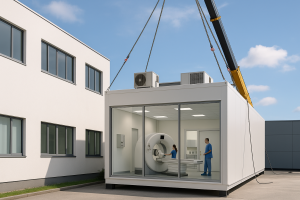
Hospitals increasingly need to modernise diagnostic facilities without interrupting patient care. Modular construction provides a practical solution, enabling high-quality, energy-efficient diagnostic suites to be delivered quickly and with minimal disruption. Prefabricated components are manufactured in controlled environments, ensuring compliance with healthcare regulations and high standards of safety.
Knowing how modular buildings are constructed also offers flexibility and scalability. Facilities such as MRI suites, CT units, and pathology labs can be expanded or upgraded faster than with traditional construction. Studies show that offsite construction can reduce on-site build times by up to 50%, which is particularly valuable in busy hospital environments (RAD Technology, 2022).
How Modular Construction Improves Energy Efficiency in Hospitals
Modular construction enhances energy efficiency through precision manufacturing. Components are built to exact specifications, which reduces thermal bridging and improves airtightness. This lowers energy consumption for heating and cooling, which accounts for a large portion of hospital operating costs.
Energy-efficient HVAC systems can be planned and installed offsite to match the specific layout of diagnostic facilities, one of the main advantages of understanding how modular buildings are constructed. Optimised HVAC installations in prefabricated healthcare buildings have been shown to reduce energy usage by up to 30% compared with conventional designs .
Lighting also contributes to energy savings. LED systems with sensors and dimming controls can be integrated during construction and tested offsite. This ensures energy performance is maximised from day one. Hospitals exploring modular upgrades can see examples of high-performance facilities designed to achieve efficiency and sustainability.
Key Design Elements of Modular Facilities That Reduce Energy Costs
High-performance building materials are fundamental to energy savings. Insulated panels, low-emissivity glazing, and advanced cladding enhance thermal performance and reduce heating and cooling demand. These materials can be installed with factory-level precision, ensuring consistent quality across modules.
Modular diagnostic facilities also incorporate energy-efficient HVAC and lighting systems with smart controls. Real-time monitoring through building management systems allows automatic adjustments to airflow, temperature, and lighting, reducing energy waste. Hospitals can fund these solutions through flexible finance options or hire and managed service programmes provided by ModuleCo Healthcare.
Renewable energy sources, including solar PV and battery storage, can also be integrated into modular designs. Advanced metering enables hospitals to track consumption and optimise usage, meaning any issues or areas of excessive use can be found easily and adjusted.
Long-Term Environmental and Financial Benefits of Modular Construction
Prefabrication minimises construction waste and carbon emissions while reducing disruption to hospital operations. Modules can be repurposed or relocated, extending their lifespan and lowering the overall environmental footprint compared with traditional builds.
Financially, understanding how modular buildings are constructed offers predictability. Reduced on-site labour, shorter timelines, and fewer delays help control costs. Alongside this, energy-efficient materials and systems further reduce operational expense in the long term.
Modular design also supports future adaptability. Facilities can accommodate technological upgrades or expansions without major structural changes, providing operational and financial flexibility over the long term.
Modular construction is an effective way to upgrade diagnostic facilities quickly, sustainably, and cost-effectively. High-performance materials, optimised HVAC and lighting, and smart energy management systems improve efficiency and reduce operational costs.