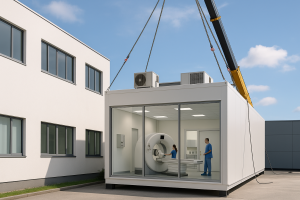
When planning a new healthcare facility, cost is always a central concern. Many healthcare developers and NHS trusts are now asking: how much does it cost to build a modular hospital, and how does it compare to traditional builds? With rising demand for efficient, scalable healthcare infrastructure, modular hospital construction is emerging as a practical alternative to conventional methods.
What’s the Difference Between Modular and Traditional Construction?
Modular construction involves fabricating building sections otherwise called modules) off-site in a controlled environment. These modules are then transported to the final location and assembled on prepared foundations. In contrast, traditional construction is built entirely on-site, often involving longer timelines and greater weather dependency.
Key Features and Delivery Models
- Speed – Modular buildings can be completed up to 50% faster than traditional ones, according to the UK’s Modular and Portable Building Association (MPBA).
- Flexibility – Modular hospitals are easier to scale or relocate, offering options for temporary or permanent use.
- Quality Control – Factory settings allow tighter quality assurance compared to the variability of on-site building.
Modular buildings for healthcare typically follow either a permanent modular construction (PMC) model or relocatable solutions. Both meet NHS design standards and clinical regulations.
Cost Comparison Breakdown
Understanding how much it costs to build a new hospital or a small healthcare facility depends on various factors including design complexity, materials, regulatory requirements, and site access. But the method of construction also plays a major role.
Upfront Build Costs and Timelines
Traditional hospitals can cost anywhere between £2,500 and £3,500 per square metre for mid-level facilities. Modular hospitals, by comparison, see cost ranges between £1,800 and £2,800 per square metre, depending on scale and customisation.
A small modular hospital with around 50 beds and limited inpatient services may cost between £25 million and £40 million, while the same hospital built using traditional methods could cost closer to £40 million to £60 million. When it comes to how much it costs to build a small hospital, modular solutions offer potential upfront savings of up to 20%.
In terms of delivery, modular builds, such as surgical hubs, typically shorten project timelines by 30 to 50%, which reduces interim costs and gets facilities operational faster.
Long-Term Value and Operational Savings
While traditional builds may offer greater architectural flexibility, modular hospitals often deliver better operational value over time:
- Energy Efficiency – Modular hospitals are usually built with modern insulation and ventilation systems that reduce energy bills.
- Reduced Maintenance – Factory-built modules experience fewer structural defects, minimising long-term repair costs.
- Less Disruption – On-site assembly is quicker and cleaner, meaning existing hospitals can expand without major disruption to care services.
These savings are even more significant when considering total lifecycle costs compared to financing options like PULSE, which cover ongoing operation, maintenance, and future upgrades.

What’s Best for Your Hospital Project?
Both construction methods can serve the healthcare sector well, but modular solutions tend to suit projects where time, budget, and scalability are high priorities. For instance, if you need an on-site sterilisation service added onto an existing space, it makes more sense to go modular than to take the traditional approach.
Whether you’re planning a full-scale facility or wondering how modular buildings are constructed for temporary clinics or specialist units, the method offers flexibility and speed without compromising quality.
Making the Financial Case for Modular
Making the case for modular involves more than just upfront savings. Decision-makers should consider:
- Faster return on investment due to earlier occupancy
- Greater certainty around build costs and project deadlines
- Lower operational costs through energy-efficient design
If you’re asking how much it costs to build a modular hospital, it’s clear the total financial benefit extends well beyond initial expenditure. With tight NHS budgets and growing demand, modular construction may not only be the more affordable option but the smarter one.