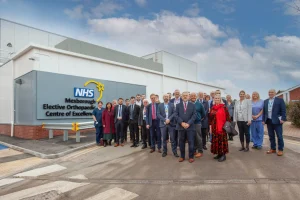
Hospitals function as complex ecosystems where every component plays a vital role in patient care. Among these components, car parks, though often overlooked, serve as the starting point for patients and the daily workplace for healthcare professionals.
Hospitals today face unprecedented pressure on their parking infrastructure. With increasing patient demand and the consolidation of health services into centralised locations, many hospitals struggle to provide adequate parking. This shortfall creates a cascade of challenges that directly impact both patient care and staff wellbeing.
The Patient Experience Begins in the Car Park
For patients, particularly those who are elderly, disabled, or seriously ill, the journey to receive care starts well before they enter the hospital doors.
- Patients arriving for appointments can often face anxiety about their health conditions, which is unnecessarily compounded by stress over finding a parking space.
- Delayed or missed appointments due to parking difficulties can disrupt carefully scheduled clinical workflows and add to backlogs.
- Family members need convenient access to remain present during critical moments in healthcare delivery.
- Emergency situations require immediate parking access without delay
Studies consistently show that difficult parking experiences increase staff and patient stress levels, potentially affecting treatment outcomes and satisfaction scores.
A 2018 survey by UNISON, involving over 3,500 health workers, revealed that 54% of NHS staff were late for work due to parking issues, with some spending up to an hour searching for a space. Additionally, 64% reported receiving fines when attempting to park at work.
When patients must circle repeatedly searching for spaces or park considerable distances from entrances, their physical energy and mood can drastically reduce before treatment even begins.
Staff Wellbeing and Retention
Healthcare professionals can work demanding shifts, often starting or ending during hours when public transportation options are limited or not running at all. Inadequate parking for staff can create significant challenges:
- Early morning or late-night shifts become more hazardous when staff must park in distant, poorly lit areas
- Time spent searching for parking reduces time between shifts and can result in late starts
- Parking difficulties add another layer of complexity in an already high-pressure profession
- Daily parking frustrations can affect job satisfaction over time
In today’s competitive healthcare recruitment landscape, seemingly small amenities like reliable parking can influence staff experience and potentially affect retention rates.
Why should NHS Trusts choose Modular Car Park Solutions
Faster Delivery with Minimal On-Site Disruption
Traditional car park construction involves months of disruptive on-site work, including heavy machinery, noise, dust, and reduced access.
Like other forms of modular construction, speed is a significant advantage, being fabricated off-site in a controlled environment; this gives us greater control over time and enables precision engineering and quality control before components ever reach the hospital.
Optimising Space with Multi-Storey Solutions
Land constraints are often a significant problem for most hospitals, particularly those in urban settings. Modular car parks can efficiently utilise vertical space through solutions ranging from single-level to 10-storey structures based on specific site requirements.
Efficient Layouts and Seamless Integration
Each hospital estate has unique requirements and space based on existing infrastructure, requiring bespoke solutions to accommodate their requirements.
Utilising modular construction enables flexible structural designs that are adaptable to irregular site shapes and conditions, allowing integration with existing hospital facilities. The result is a parking solution that feels like a natural extension of the hospital site.
A Cost-Effective and Sustainable Investment
Beyond the immediate benefits, modular car park solutions can deliver lower lifetime maintenance costs through advanced materials and engineering, coupled with energy-efficient lighting and ventilation systems that reduce operational expenses.
The potential for utilising bespoke funding solutions can align with hospital financial planning cycles, while reduced construction waste compared to traditional methods supports sustainability goals.
Ensuring the quality of care before patients enter the hospital
Ultimately, hospital parking transcends convenience; it directly impacts care quality. When patients arrive calm rather than frustrated, when staff begin shifts without parking-related stress, and when emergencies receive immediate access, the entire hospital environment benefits.
Investing in adequate parking infrastructure represents a commitment to comprehensive patient care and staff support. Parking is an essential component of healthcare delivery, and it should be treated as such.
By choosing modular construction, hospitals gain not just additional parking capacity, but a strategic asset that enhances patient and staff experience.
With over two decades of experience in delivering flexible finance solutions to the NHS, including bespoke car parking, ModuleCo Healthcare is uniquely positioned to support hospitals and NHS trusts in addressing their parking challenges.
As hospitals evolve and expand their services, we’d love to discuss how our modular car park solutions and flexible hire options could provide more efficient, responsive parking infrastructure that truly prioritises staff wellbeing and enhances the patient care from the moment they arrive on site.
Get in touch with a member of our team via sales@healthcarehire.co.uk to explore how we can transform your hospital’s parking capacity with minimal disruption to your vital healthcare services.